

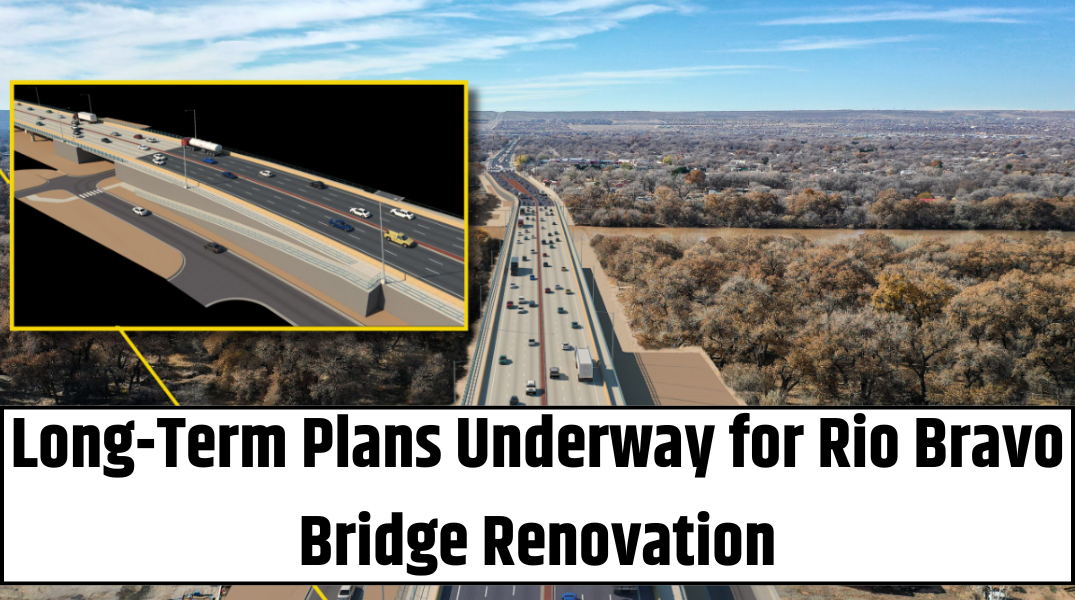
ALBUQUERQUE, N.M. – Drivers crossing the Rio Grande in Albuquerque are being asked to prepare for a long-term infrastructure project as the New Mexico Department of Transportation (NMDOT) announced plans to reconstruct the Rio Bravo Bridge. The renovation, expected to begin as early as next month, will be the final phase of a series of road improvement projects along Rio Bravo Boulevard and could take up to three years to complete.
The Rio Bravo Bridge spans the Rio Grande between Isleta and Second Street, serving as a critical artery for commuters, commercial traffic, and pedestrians. Over the last several years, NMDOT and Bernalillo County have worked on a variety of projects along Rio Bravo Boulevard, including the Rio Bravo Interchange in 2017 and the “Rio Bravo Boulevard Gap” project connecting the freeway to Second Street. The bridge reconstruction marks the final step in completing the multi-year effort to modernize the corridor and improve traffic flow.
Kimberly Gallegos, District 3 Public Information Officer for NMDOT, highlighted the upgrades planned for the bridge. “There’s going to be new sidewalks, there’s going to be multi-use trails, there’s going to be new lighting, there’s going to be Intelligent Transportation Systems, drainage improvements,” she said. The improvements are designed to enhance safety and convenience for drivers, bicyclists, and pedestrians, reflecting a modern approach to infrastructure development.
Also Read – Albuquerque Community Safety Receives Funding for Substance Abuse Services
The project will also involve widening the bridge to accommodate increased traffic capacity, adding noise and retaining walls, and updating signage and striping to improve navigation. According to Gallegos, these measures will not only increase traffic flow but also improve overall safety over the river and reliability for commuters. “It’s going to improve the traffic flow, it’s going to improve safety over the river and also overall travel reliability so people can get to their destinations quicker,” she said.
NMDOT officials emphasized that the bridge is approaching the end of its functional lifespan. Structural concerns and the need for updated safety measures make the reconstruction a necessity rather than a convenience. Maintaining access to the bridge during construction is a key consideration, and officials said lane closures will occur but the bridge will not be completely closed to traffic. This strategy aims to reduce the impact on commuters and minimize disruptions while still allowing for substantial construction progress.
To further mitigate traffic impacts, NMDOT plans to implement detours and phased construction zones. Drivers are advised to plan for delays, particularly during peak commuting hours, and to explore alternate routes where possible. Construction crews will work in stages to maintain traffic flow, and residents are being asked for patience as the project progresses. “We’re trying to provide less impacts to traffic while still getting the job done, so definitely we appreciate your patience. We ask that you just bear with us,” Gallegos said.
The bridge reconstruction is part of a broader effort to enhance the safety, accessibility, and functionality of Albuquerque’s transportation network. The inclusion of sidewalks and multi-use trails reflects a growing trend to make road infrastructure more pedestrian- and bicycle-friendly, while the implementation of Intelligent Transportation Systems is expected to optimize traffic management and improve real-time monitoring of conditions. Drainage improvements will address flooding concerns, ensuring the bridge remains safe and operational during periods of heavy rainfall or river level fluctuations.
Costing an estimated $117 million, the Rio Bravo Bridge project represents one of the city’s most significant infrastructure investments in recent years. The expected completion date is spring 2029, meaning the bridge will undergo major reconstruction over the course of three construction seasons. While the long timeline may inconvenience some drivers, officials insist the project’s benefits outweigh the temporary disruptions, offering long-term improvements for the metro area’s traffic safety, efficiency, and connectivity.
Public feedback has generally been supportive of the project, with many residents recognizing the importance of maintaining critical infrastructure before deterioration leads to more serious problems. City planners and transportation officials have emphasized that strategic investments now can prevent higher costs and potential hazards in the future. Residents have also praised the inclusion of pedestrian and bicycle-friendly elements, noting that multi-use trails and enhanced sidewalks will encourage more active transportation and improve access across the Rio Grande.
The Rio Bravo Bridge renovation is expected to become a landmark improvement for Albuquerque, not only upgrading a critical commuter route but also enhancing the city’s infrastructure resilience for decades to come. By incorporating modern safety features, updated signage, improved traffic management technology, and better accommodations for non-motorized traffic, NMDOT aims to ensure that the bridge can continue to serve as a vital transportation link well into the future.
Also Read – Albuquerque Road Rage Tragedy: 10-Year Anniversary of 4-Year-Old’s Death
As construction begins later this year, drivers, bicyclists, and pedestrians are encouraged to monitor updates from NMDOT and local news sources regarding detours, lane closures, and progress reports. Public cooperation and awareness will be critical in ensuring that the project proceeds safely and efficiently.
While the multi-year project will require patience, the Rio Bravo Bridge reconstruction promises substantial long-term benefits for Albuquerque’s residents and visitors alike. Enhanced traffic flow, improved safety, expanded pedestrian and bicycle access, and modern infrastructure technology are expected to transform the corridor into a more reliable and user-friendly route, demonstrating a commitment to long-term urban planning and transportation innovation.
With a price tag of $117 million and completion expected in spring 2029, the Rio Bravo Bridge project stands as a significant investment in Albuquerque’s future mobility, connectivity, and public safety. For residents commuting across the Rio Grande, the coming years will bring temporary inconvenience but ultimately a safer, more efficient, and modern bridge that meets the city’s evolving needs.