


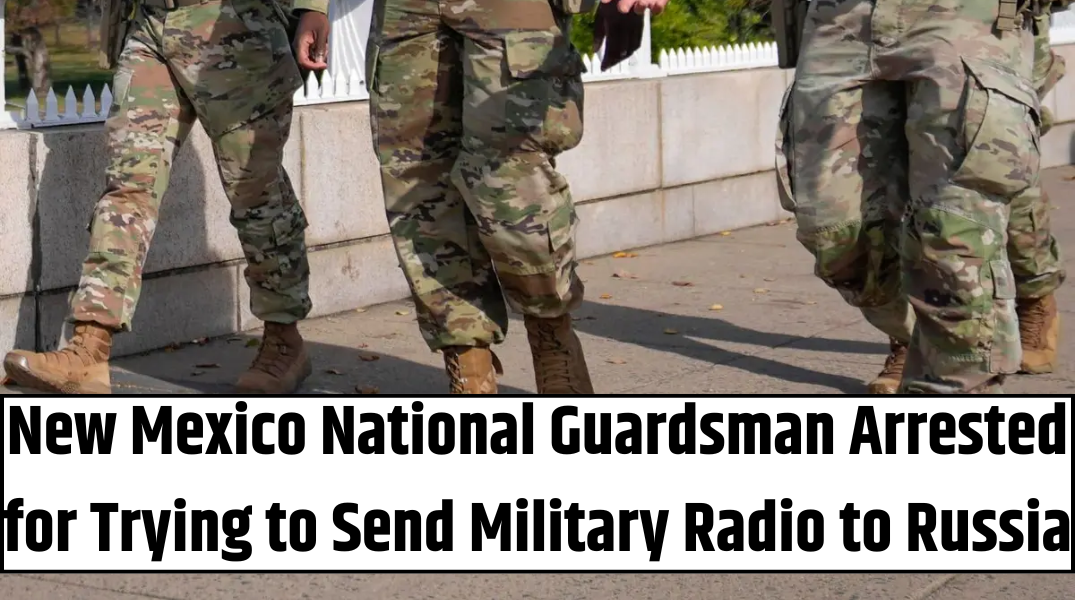
ALAMOGORDO, N.M. — A New Mexico National Guardsman has been arrested and charged with attempting to violate U.S. export control laws after allegedly conspiring to provide sensitive military equipment to a foreign intelligence service.
Federal prosecutors announced on Tuesday that 28-year-old Canyon Anthony Amarys, a resident of Alamogordo, faces a federal indictment accusing him of trying to aid a Russian intelligence service by obtaining and attempting to export restricted military hardware.
Allegations of Covert Cooperation
According to court documents unsealed this week, investigators say Amarys believed he was entering into a covert relationship with an agent representing the Russian government. The indictment alleges that in February 2025, Amarys met in person with an individual he thought was affiliated with Russian intelligence and signed a one-page document formalizing his supposed cooperation.
The agreement reportedly outlined his willingness to undertake specific assignments, including photographing a U.S. military installation at Fort Riley, Kansas, and acquiring a restricted helicopter radio system intended for eventual use by the Russian military. Prosecutors claim that Amarys’s actions demonstrated both knowledge and intent to circumvent American export laws.
Also Read – 17-Year-Old Suspect Arrested in Oregon Park Shooting of Middle Schooler
Attempted Purchase and Export of Controlled Equipment
The investigation found that Amarys purchased a helicopter radio classified under U.S. export control regulations—a piece of technology requiring a license from the U.S. Department of Commerce to be legally shipped abroad. Federal authorities say that in March 2025, Amarys traveled to Kansas to retrieve the equipment and make arrangements to send it overseas.
Amarys allegedly planned to ship the device to a contact in Romania, whom he believed would forward it on to Russia. Court filings show that he remained in communication with the person he thought was a Russian intelligence operative throughout the process, confirming his understanding that the item would be unlawfully diverted to Russian hands.
According to prosecutors, Amarys researched export laws online before making the purchase, which they say proves he was aware his actions were illegal. His alleged efforts to conceal the true destination of the radio further underscored the seriousness of the offense.
Federal Investigation and Arrest
The case came to light following a joint investigation involving the Federal Bureau of Investigation (FBI), the Department of Commerce’s Office of Export Enforcement, and the U.S. Army Counterintelligence Command. Authorities said the operation exposed Amarys’s communications and prevented the illegal export before any sensitive technology left the country.
Agents arrested Amarys in Alamogordo earlier this week. During the arrest, federal investigators reportedly recovered the radio that he had intended to send abroad. Officials confirmed that no classified materials were transmitted and that the attempted export was intercepted before any harm to U.S. national security occurred.
“This arrest demonstrates our continued vigilance in protecting U.S. military technology and preventing its unlawful transfer to foreign powers,” said Assistant Attorney General Matthew Olsen of the Justice Department’s National Security Division. “The Export Control Reform Act exists to safeguard America’s most sensitive defense technologies from misuse by adversaries.”
Legal Context: The Export Control Reform Act
The Export Control Reform Act (ECRA) is a federal statute designed to regulate the export of sensitive technologies, software, and equipment that could impact national security or foreign policy interests. Under ECRA, exporting certain military-related or dual-use items requires explicit authorization from the Department of Commerce. Violations of the law can carry significant penalties, including lengthy prison sentences and substantial fines.
Legal experts say the Amarys case highlights the growing importance of export compliance in an era of heightened geopolitical tension. “The U.S. government is increasingly prioritizing enforcement of export controls, particularly when items have potential military applications,” said Dr. Jonathan Marks, a national security analyst at Georgetown University. “Attempting to send such technology to an adversarial nation, even indirectly, is viewed as a grave national security threat.”
Potential Penalties and Next Steps
If convicted, Amarys could face up to 20 years in federal prison and substantial monetary penalties. Prosecutors are also exploring whether additional charges, such as attempted espionage or conspiracy to defraud the United States, may apply based on the evidence gathered.
Amarys made his initial appearance in federal court in Las Cruces earlier this week, where he was advised of the charges against him. The judge ordered him detained pending a detention hearing scheduled for next week, citing the nature of the allegations and potential flight risk.
Defense counsel for Amarys has not issued a public statement, though court records indicate he intends to plead not guilty. Legal proceedings are expected to continue into early 2026, as prosecutors review electronic communications and financial records connected to the case.
Broader Implications
National security officials warn that the attempted transfer of sensitive technology to Russia represents part of a broader pattern of foreign efforts to obtain U.S. defense-related equipment. In recent years, federal agencies have stepped up investigations into illicit procurement networks, particularly those using intermediaries in Eastern Europe and Asia to bypass export restrictions.
“Protecting U.S. military technology isn’t just about safeguarding equipment—it’s about preserving the strategic advantage of the nation’s armed forces,” said FBI Special Agent in Charge William Davis. “This case underscores the continuing threat posed by foreign intelligence services attempting to exploit individuals with military access.”
Community Reaction
News of Amarys’s arrest has stunned residents of Alamogordo, where he was known both as a National Guardsman and community member. Many expressed disbelief that someone in uniform could be accused of aiding a foreign adversary. “It’s shocking,” said one neighbor, who declined to be named. “You see someone in the Guard and you assume they’re serving the country, not working against it.”
Also Read – Holloman Lake Closing to Public Aug. 14 Over PFAS Contamination
Authorities stress that the alleged actions of one individual do not reflect the integrity or commitment of the broader National Guard community. The New Mexico National Guard has confirmed that Amarys has been suspended from duty pending the outcome of the federal case.
As the investigation continues, federal officials reaffirmed their commitment to ensuring that sensitive military technologies remain out of the hands of adversarial nations. “The laws protecting our defense assets are non-negotiable,” Assistant Attorney General Olsen said. “Those who try to undermine them—whether through greed, ideology, or manipulation—will face justice.”